


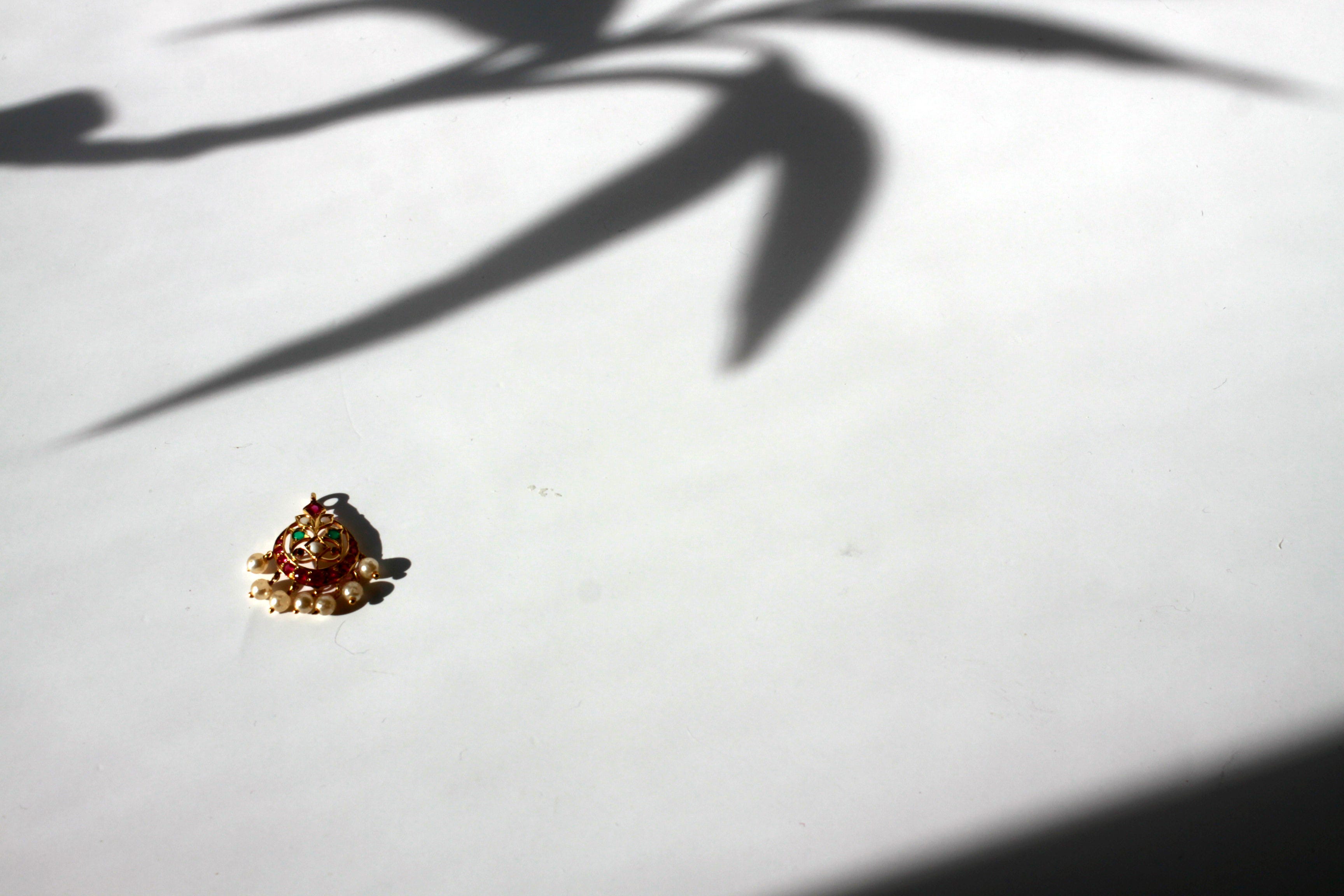
Almost every woman of South Asian origin has a collection of traditional jewelry hidden away somewhere. We may receive a small piece from an elderly female relative at the time of our birth, and the collection slowly increases, bit by bit, as we achieve various milestones in our lives - graduation, marriage, children. When our own children become older, that jewelry is passed on to them, for themselves or their partners, and eventually their own children. While these objects often indicate social status and act as a form of portable wealth, in the diaspora they’re also a reminder of our heritage and the people who brought us here.
South Asian jewelry has a long tradition. Originating 5000 years ago in the Indus Valley Civilization, it serves as a fascinating record of the history of the Indian subcontinent. Beginning with simple beads and evolving into intricate designs with gold, silver, and gemstones, it reflects the transition of a culture which remains heavily influenced by the Hindu religion in the South and the Mughal Empire with Persian influences in the North.
When India was divided by the British in 1947, as many as 20 million people were internally displaced as they migrated to or from India and the newly created country of Pakistan. As refugees, they took only what they could carry, and for many women, this included their jewelry which could be hidden easily on their bodies in the event of attack by bandits as they crossed the borders. As a result, jewelry which dates back to the era prior to 1947 is especially meaningful.
Although much South Asian jewelry is incredibly ornate and littered with gold and precious stones, the truly powerful pieces are much quieter. These are the tiny earrings for daily use, the thin gold bracelets, or the small tikka meant to be worn at your wedding. When a number of pieces from my own small collection were stolen a few years ago, what I mourned were not the larger and more expensive necklaces, but a very small pair of emerald earrings given to me by my mother. I had worn these earrings throughout my residency, during my pregnancy, and after the birth of my son, and therefore they had symbolized the concept of family to me in a very concrete fashion.
But in reality family is complicated and frequently messy. Thanksgiving is a highly idealized American holiday that supposedly brings family members together in harmony as they share a traditional meal to commemorate the 1621 Harvest Feast held between grateful colonists and the native Wampanoag. The reality is that Thanksgiving occurred during a period of terrible conflict and loss for the Indigenous people who still term this day a “National Day of Mourning”. Many Americans aren’t aware of this, or simply don’t want to be; the fantasy of family is easier.
Perhaps, then, it’s not even remotely ironic that over 46 million turkeys are slaughtered each year in celebration of an event where a large number of people who happen to share a last name battle traffic and distance to come together to criticize, argue, and glare at each other over a table laden with enough calories for a week. I’ve been a vegetarian for a long time, but it’s not only the turkey carnage that bothers me each year. Every November, I inject more Botox® into faces than I do at any other time of year. I repeatedly hear the statement, “I’m going to see my family for Thanksgiving and I need to look good so that they don’t criticize me.” The first time I heard this from a patient, I was shocked. Now I’m just saddened. Is it really “family” if they don’t accept you as you are, with all of your beautiful wrinkles and folds? Sometimes the blood of family is just…blood.
Almost 17 years ago, I met my close friend Shobha in Soho for a quick lunch. We were both heavily pregnant at the time, and naturally we managed to select a tiny cafe with almost no room between the tables. As we maneuvered through the obstacle course of the restaurant with the assistance of a very kind waitress, I remember thinking that there must be a special bond between two people who simultaneously bang into other people and objects with their pregnant abdomens. And of course there is.
There is a bond that surpasses blood and name, and it’s formed in the moments when we share quiet meals in restaurants discovered on side streets, bring our children together for bagels and Chinese food, and dissect how to find meaning in a world that feels increasingly chaotic. It can take our entire lives to find those connections; some of us never do. South Asian jewelry is symbolic, of course, but it endures because it represents the strength of those deeper bonds. When it’s passed on to the people who act and feel like family, rather than those who merely share a name, it takes on a more profound meaning that redefines the concept of family.
Dedicated with much love to my “sister”, Shobha Tummala.
references:
https://en.wikipedia.org/wiki/Partition_of_India
Larry Collins, Dominique Lapierre. Freedom at Midnight. Simon & Schuster, 1975.
Bernadette van Gelder. Traditional Indian Jewelry. ACC Art Books, 2018.
https://nativepartnership.org/the-real-thanksgiving-story/
Very interesting piece
Thank you for this beautiful piece of writing that touched me deeply. You have an enormous heart and are so generous with me and so many others. I feel honored to be a part of your life and even more to be called your sister. I love you Nina! 💕